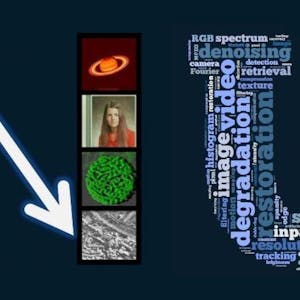
Fundamentals of Digital Image and Video Processing
$49
ENROLL NOWCourse Overview
What You'll Learn
- In this class you will learn the basic principles and tools used to process images and videos, and how to apply them in solving practical problems of commercial and scientific interests.
- The ability to process image and video signals is therefore an incredibly important skill to master for engineering/science students, software developers, and practicing scientists.
- In this class not only will you learn the theory behind fundamental processing tasks including image/video enhancement, recovery, and compression - but you will also learn how to perform these key processing tasks in practice using state-of-the-art techniques and tools.
In this class you will learn the basic principles and tools used to process images and videos, and how to apply them in solving practical problems of commercial and scientific interests. Digital images and videos are everywhere these days – in thousands of scientific (e.g., astronomical, bio-medical), consumer, industrial, and artistic applications. Moreover they come in a wide range of the electromagnetic spectrum - from visible light and infrared to gamma rays and beyond. The ability to process image and video signals is therefore an incredibly important skill to master for engineering/science students, software developers, and practicing scientists. Digital image and video processing continues to enable the multimedia technology revolution we are experiencing today. Some important examples of image and video processing include the removal of degradations images suffer during acquisition (e.g., removing blur from a picture of a fast moving car), and the compression and transmission of images and videos (if you watch videos online, or share photos via a social media website, you use this everyday!), for economical storage and efficient transmission. This course will cover the fundamentals of image and video processing. We will provide a mathematical framework to describe and analyze images and videos as two- and three-dimensional signals in the spatial, spatio-temporal, and frequency domains. In this class not only will you learn the theory behind fundamental processing tasks including image/video enhancement, recovery, and compression - but you will also learn how to perform these key processing tasks in practice using state-of-the-art techniques and tools. We will introduce and use a wide variety of such tools – from optimization toolboxes to statistical techniques. Emphasis on the special role sparsity plays in modern image and video processing will also be given. In all cases, example images and videos pertaining to specific application domains will be utilized.
Course FAQs
Is this an accredited online course?
Accreditation for 'Fundamentals of Digital Image and Video Processing' is determined by the provider, Northwestern University. For online college courses or degree programs, we strongly recommend you verify the accreditation status directly on the provider's website to ensure it meets your requirements.
Can this course be used for continuing education credits?
Many of the courses listed on our platform are suitable for professional continuing education. However, acceptance for credit varies by state and licensing board. Please confirm with your board and {course.provider} that this specific course qualifies.
How do I enroll in this online school program?
To enroll, click the 'ENROLL NOW' button on this page. You will be taken to the official page for 'Fundamentals of Digital Image and Video Processing' on the Northwestern University online class platform, where you can complete your registration.